Vladimir Lenin: Difference between revisions
Created page with '{{Use dmy dates|date=August 2010}} {{Infobox officeholder |name = Vladimir Ilyich Lenin <small><div class="center">Владимир Ильич Ленин</div></small> |image = L...' |
No edit summary |
||
| (7 intermediate revisions by the same user not shown) | |||
| Line 1: | Line 1: | ||
{{ | :''Cloned from [[:en:Vladimir Lenin]] 2011-06-25'' | ||
'''Vladimir Ilyich Lenin''' (22 April 1870 – 21 January 1924), was a [[Russia]]n [[revolutionary]], author, lawyer, economic theorist, [[political philosopher]], creator of the [[Communist Party of the Soviet Union|Soviet Communist Party]], [[leader]] of the [[October Revolution|1917 October Revolution]], and founder of the [[Union of Soviet Socialist Republics|USSR]]. As head of the [[Bolsheviks]] (1917–1924) he led the [[Red Army]] to victory in the [[Russian Civil War]], before establishing the world's first officially [[Socialism (Marxism)|socialist]] state. | |||
{{TOCleft}} | |||
As a theorist, his extensive theoretical and [[philosophy|philosophical]] contributions to [[Marxism]] produced [[Leninism]].<ref>Триумф и Трагедия И. В. Сталин: политический портрет. (''Triumph and Tragedy – I. V. Stalin : A Political Portrait'') Дмитрий Волкогонов (Dmitriy Volkogonov). Book 1, Part 1, pp. 95–114. Новости Publications. Moscow. 1989.</ref> As the principal founder of the first socialist state he is without peer in the practical application of that theory and his early death is widely credited as the subjective factor ultimately responsible for the degeneration of the Russian Revolution into the Stalinist state.<ref>[http://www.socialistappeal.org/faq/stalinism.html ''The Rise of Stalinsim''] socialistappeal.org</ref><ref>[http://www.marxists.org/archive/james-clr/works/world/ch07.htm ''Stalin Kills the 1923 Revolution''] C.L.R. James, §: THE SIGNIFICANCE OF 1923 </ref><ref>[http://www.newstatesman.com/200002280021 ''The [[New Statesman]] Interview - [[Barbara Castle]]'' ] </ref> | |||
{{Infobox officeholder | {{Infobox officeholder | ||
|name = Vladimir Ilyich Lenin | |name = Vladimir Ilyich Lenin | ||
| Line 33: | Line 37: | ||
|signature = Unterschrift_Lenins.svg | |signature = Unterschrift_Lenins.svg | ||
}} | }} | ||
==Early life and background== | ==Early life and background== | ||
Lenin was born Vladimir Ilyich Ulyanov ({{lang-rus|Владимир Ильич Ульянов}}) on {{OldStyleDate|22 April|1870|10 April}} in the town of [[Simbirsk]] in the [[Russian Empire]]. Simbirsk, a rural town on the [[River Volga]] nearly 1,500 miles from the capital [[Saint Petersburg]], would be renamed upon Ulyanov's death fifty-four years later as "Ulyanovsk" in his honour. That same year, Saint Petersburg itself would be renamed Leningrad after Ulyanov's better-known [[Pseudonym|cadre name]]. [[File:Lenin Age 4.jpg|left|thumb|135px|"Volodya", aged three]] | Lenin was born Vladimir Ilyich Ulyanov ({{lang-rus|Владимир Ильич Ульянов}}) on {{OldStyleDate|22 April|1870|10 April}} in the town of [[Simbirsk]] in the [[Russian Empire]]. Simbirsk, a rural town on the [[River Volga]] nearly 1,500 miles from the capital [[Saint Petersburg]], would be renamed upon Ulyanov's death fifty-four years later as "Ulyanovsk" in his honour. That same year, Saint Petersburg itself would be renamed Leningrad after Ulyanov's better-known [[Pseudonym|cadre name]]. [[File:Lenin Age 4.jpg|left|thumb|135px|"Volodya", aged three]] | ||
| Line 199: | Line 198: | ||
===Red Terror=== | ===Red Terror=== | ||
{{Main|Red Terror}} | |||
[[File:Tov lenin ochishchaet.jpg|thumb|upright|right|200px|A picture saying, "Comrade Lenin Cleanses the Earth of Filth"]] | [[File:Tov lenin ochishchaet.jpg|thumb|upright|right|200px|A picture saying, "Comrade Lenin Cleanses the Earth of Filth"]] | ||
| Line 313: | Line 312: | ||
==Legacy== | ==Legacy== | ||
{{Cquote2|As influential as he was in life, Lenin may have been more so in death. Over 100 million have lined up to view [[Lenin's Mausoleum|his mummified body]]. His memory has been used to support every change in Soviet policy and every new regime since his death. His theories inspired the successful revolutions of [[Fidel Castro]], [[Mao Zedong]], and [[Ho Chi Minh]]; as well as countless other revolutionaries in countries full of oppressed and powerless people.| ''Vladimir Lenin: Voice of Revolution'', [[A&E Network|A&E]] [[Biography (TV series)|Biography]], 2005 <ref name = "LeninDoc" />}} | {{Cquote2|As influential as he was in life, Lenin may have been more so in death. Over 100 million have lined up to view [[Lenin's Mausoleum|his mummified body]]. His memory has been used to support every change in Soviet policy and every new regime since his death. His theories inspired the successful revolutions of [[Fidel Castro]], [[Mao Zedong]], and [[Ho Chi Minh]]; as well as countless other revolutionaries in countries full of oppressed and powerless people.| ''Vladimir Lenin: Voice of Revolution'', [[A&E Network|A&E]] [[Biography (TV series)|Biography]], 2005 <ref name = "LeninDoc" />}} | ||
[[Image:URSS_1_rublo_centenario_nascita_Lenin.JPG| Commemorative [[Soviet rouble|one rouble]] coin minted in 1970, in honor of Lenin's 100th birthday.|thumb|upright|right]] | |||
When Lenin died on January 21, 1924, near Moscow, he was acclaimed as "the greatest genius of mankind" and "the leader and teacher of the peoples of the whole world."<ref name = "1968Encyclopedia">[http://www.encyclopedia.com/topic/Vladimir_Ilyich_Lenin.aspx Lenin] entry from the ''[[International Encyclopedia of the Social Sciences]]'', 1968</ref> Historian [[J. Arch Getty]] has remarked that "Lenin deserves a lot of credit for the notion that the meek can inherit the earth, that there can be a political movement based on [[social justice]] and [[Social equality|equality]]."<ref name = "LeninDoc" /> ''Time Magazine'' also named Lenin one of the [[Time 100: The Most Important People of the Century|100 most important people of the 20th century]],<ref>[http://205.188.238.181/time/time100/leaders/profile/lenin.html Time 100:Vladimir Lenin] by David Remnick, April 13, 1998.</ref> and one of their top 25 political icons of all time; remarking that "for decades, [[Marxist-Leninist]] rebellions shook the world while Lenin's embalmed corpse lay in repose in the [[Red Square]]."<ref>[http://www.time.com/time/specials/packages/article/0,28804,2046285_2045996_2046096,00.html Top 25 Political Icons: Lenin] by Feifei Sun, ''[[Time Magazine]]'', February 4, 2011</ref> Following the dissolution of the USSR in 1991, reverence for Lenin declined among the post-Soviet generations, yet he remains an important historical figure for the Soviet-era generations.<ref> | When Lenin died on January 21, 1924, near Moscow, he was acclaimed as "the greatest genius of mankind" and "the leader and teacher of the peoples of the whole world."<ref name = "1968Encyclopedia">[http://www.encyclopedia.com/topic/Vladimir_Ilyich_Lenin.aspx Lenin] entry from the ''[[International Encyclopedia of the Social Sciences]]'', 1968</ref> Historian [[J. Arch Getty]] has remarked that "Lenin deserves a lot of credit for the notion that the meek can inherit the earth, that there can be a political movement based on [[social justice]] and [[Social equality|equality]]."<ref name = "LeninDoc" /> ''Time Magazine'' also named Lenin one of the [[Time 100: The Most Important People of the Century|100 most important people of the 20th century]],<ref>[http://205.188.238.181/time/time100/leaders/profile/lenin.html Time 100:Vladimir Lenin] by David Remnick, April 13, 1998.</ref> and one of their top 25 political icons of all time; remarking that "for decades, [[Marxist-Leninist]] rebellions shook the world while Lenin's embalmed corpse lay in repose in the [[Red Square]]."<ref>[http://www.time.com/time/specials/packages/article/0,28804,2046285_2045996_2046096,00.html Top 25 Political Icons: Lenin] by Feifei Sun, ''[[Time Magazine]]'', February 4, 2011</ref> Following the dissolution of the USSR in 1991, reverence for Lenin declined among the post-Soviet generations, yet he remains an important historical figure for the Soviet-era generations.<ref> | ||
| Line 358: | Line 359: | ||
==See also== | ==See also== | ||
{ | {| | ||
| | |||
*[[Leninism]] | *[[Leninism]] | ||
*[[Lenin's national policy]] | *[[Lenin's national policy]] | ||
*[[History of the Jews in Russia#Soviet Union before World War II|Lenin's stance on anti-Semitism]] | *[[History of the Jews in Russia#Soviet Union before World War II|Lenin's stance on anti-Semitism]] | ||
*[[Marxist–Leninist atheism]] | *[[Marxist–Leninist atheism]] | ||
| | |||
*[[Lenin's Testament]] | *[[Lenin's Testament]] | ||
*[[Anti-Leninism]] | *[[Anti-Leninism]] | ||
*[[Lenin Prize]] | *[[Lenin Prize]] | ||
*[[Lenin Peace Prize]] | *[[Lenin Peace Prize]] | ||
| | |||
*[[Order of Lenin]] | *[[Order of Lenin]] | ||
*[[Lenin's Mausoleum]] | *[[Lenin's Mausoleum]] | ||
*[[List of statues of Lenin]] | *[[List of statues of Lenin]] | ||
*[[List of places named after Lenin]] | *[[List of places named after Lenin]] | ||
|} | |||
==References== | ==References== | ||
Latest revision as of 23:15, 25 June 2011
- Cloned from en:Vladimir Lenin 2011-06-25
Vladimir Ilyich Lenin (22 April 1870 – 21 January 1924), was a Russian revolutionary, author, lawyer, economic theorist, political philosopher, creator of the Soviet Communist Party, leader of the 1917 October Revolution, and founder of the USSR. As head of the Bolsheviks (1917–1924) he led the Red Army to victory in the Russian Civil War, before establishing the world's first officially socialist state.
As a theorist, his extensive theoretical and philosophical contributions to Marxism produced Leninism.[1] As the principal founder of the first socialist state he is without peer in the practical application of that theory and his early death is widely credited as the subjective factor ultimately responsible for the degeneration of the Russian Revolution into the Stalinist state.[2][3][4]
| Vladimir Ilyich Lenin
Владимир Ильич Ленин
| |
 | |
| In office 30 December 1922 – 21 January 1924 | |
| Preceded by | Position created |
|---|---|
| Succeeded by | Alexey Rykov |
| In office 8 November 1917 – 21 January 1924 | |
| Preceded by | Position created |
| Succeeded by | Alexey Rykov |
| In office 17 November 1903 – 21 January 1924 | |
| Preceded by | Position created |
| Succeeded by | Joseph Stalin (as General Secretary) |
| Personal details | |
| Born | Template:Br separated entries |
| Died | Template:Br separated entries |
| Nationality | Soviet Russian |
| Political party | Russian Communist Party (bolsheviks) |
| Spouse(s) | Nadezhda Krupskaya (1898–1924) |
| Profession | Lawyer, revolutionary, politician |
| Religion | None |
| Signature | File:Unterschrift Lenins.svg |
Early life and background
Lenin was born Vladimir Ilyich Ulyanov (Template:Lang-rus) on Template:OldStyleDate in the town of Simbirsk in the Russian Empire. Simbirsk, a rural town on the River Volga nearly 1,500 miles from the capital Saint Petersburg, would be renamed upon Ulyanov's death fifty-four years later as "Ulyanovsk" in his honour. That same year, Saint Petersburg itself would be renamed Leningrad after Ulyanov's better-known cadre name.

Lenin's parents were Maria Alexandrovna Ulyanova, a schoolteacher, and Ilya Nikolayevich Ulyanov, a government education official. Lenin was baptised on Template:OldStyleDate at the local church of St. Nicholas into the Russian Orthodox Church.[5][6] Lenin came from a diverse ancestry. He was of Russian, German, and Swedish descent, and his maternal grandfather descended from the Jewish Blank family. Lenin is also believed to have had Kalmyk ancestry on his father's side.[7][8]
In a letter to Joseph Stalin in 1932 - six years after Lenin's death - Anna Ulyanova, Lenin's older sister, wrote that their maternal grandfather "came from a poor Jewish family and was, according to his baptismal certificate, the son of Moses Blank." Blank was born a Ukrainian Jew in Zhitomir, Ukraine, and converted to Christianity to escape the Pale of Settlement and gain access to higher education. In her letter, Ulyanova said her brother "had always thought highly of Jews." She also urged Stalin to reveal Lenin's Jewish background, concluding that "it would be wrong to hide it from the masses." Stalin, however, ordered Ulyanova to keep Lenin's Jewish roots under wraps. A few years later, Stalin began to purge Jews from among the leaders of the revolution.[9]
Lenin was born into a comfortable middle-class family. Lenin's father Ilya was elevated into the Russian nobility for his work in the government bureaucracy, and, after being appointed director of Simbirsk's primary schools in 1874, was entitled to wear a blue gold-embroidered uniform and be addressed as "Your Excellency".[10] Although later Soviet biographies tried to disguise his background, Lenin himself never made any effort to hide the fact that he was a nobleman by birth.[7] Lenin argued explicitly in one of his most famous works What Is To Be Done? that intellectuals from "bourgeois" backgrounds have a vital revolutionary role to play bringing political ideas to the working-class movement: "By their social status the founders of modern scientific socialism, Marx and Engels, themselves belonged to the bourgeois intelligentsia."[11]
Athletically, Lenin was a good swimmer and ice skater, who later attended the Simbirsk Men's Gymnasium which was headed by the father of Alexander Kerensky and graduated in 1887 with a gold medal.
Being of the intelligentsia, the Ulyanovs educated their children (all of which except one become revolutionaries[12]) against the ills of their time (violations of human rights, servile psychology, etc.), and instilled a readiness in them to struggle for higher ideals, a free society, and equal rights. Lenin in particular was impressed by his father’s descriptions of the "darkness" of life in the villages and of the arbitrary treatment of peasants by officials.[13] Lenin, an intelligent and conscientious student who loved playing chess, also became a voracious reader, enjoying the writings of Alexander Pushkin, Ivan Turgenev, Leo Tolstoy, and Nikolay Nekrasov.[13] Additionally, he read the works of protorevolutionary writers such as Vissarion Belinsky, Alexander Herzen, Dmitry Pisarev, and Nikolay Dobrolyubov.[13]

Brother's execution and radicalization
Following his father's January 1886 death from a brain hemorrhage, a number of events contributed to Lenin's radicalization. In May 1887 (when Lenin was 17 years old), his eldest brother Aleksandr Ulyanov was hanged for participating in an assassination attempt against the Tsar, Alexander III (1881–94).[14] His sister, Anna Ulyanova, who was arrested with his brother Aleksandr, was then banished to an Ulyanov family estate at Kokushkino, a village some 40 km (25 mi.) from Kazan. These events helped transform Lenin into a political radical. During this time, Lenin was also influenced by the writings of Georgi Plekhanov, and most importantly, Nikolay Chernyshevsky's 1863 novel What is to be Done?.[15]
Complementing these personal, emotional, and political upheavals was his matriculation, in August 1887, to the Kazan University, where he studied law and read the works of Karl Marx and Freidrich Engels.[15] That Marxism-derived political development involved Lenin in a student riot, and consequent arrest, in December 1887; Kazan University expelled him and the police authorities barred him from other universities. After this, he was under continuous police surveillance as the brother of a known terrorist.[16] Nevertheless, he studied independently and earned a law degree; at that time, he first read Das Kapital (1867–94). Three years later, in 1890, he was permitted to study at the University of Saint Petersburg.[17] In January 1892, he was awarded a first class diploma in law;[18] moreover, he was an intellectually distinguished student in the Classical languages of Latin and Greek, and the modern languages of German, French, and English, but had only limited command of the latter two. In the 1917 revolutionary period, he relied upon Inessa Armand to translate an article of his into French and English; and wrote to S. N. Ravich in Geneva, "I am unable to lecture in French".[19]
Revolutionary

Lenin practised law in the Volga River port of Samara for a few years, mostly land-ownership cases, from which he derived political insight to the Russian peasants' socio-economic condition;[20] in 1893, he moved to St Petersburg, and practised revolutionary propaganda. In 1895, he founded the League of Struggle for the Emancipation of the Working Class, the consolidation of the city's Marxist groups; as an embryonic revolutionary party, the League was active among the Russian labour organisations. On 7 December 1895, Lenin was arrested for plotting against Tsar Alexander III, and was then imprisoned for fourteen months in solitary confinement Cell 193 of the St. Petersburg Remand Prison.[21] In February 1897, he was exiled to eastern Siberia, to the village Shushenskoye in the Minusinsky District, Yenisei Gubernia. There, he met Georgy Plekhanov, the Marxist who introduced socialism to Russia. In July 1898, Lenin married the socialist activist Nadezhda Krupskaya, and, in April 1899, he published the book The Development of Capitalism in Russia[22] (1899), under the pseudonym of Vladimir Ilyin; one of the thirty theoretical works he wrote in exile.[21]

At the end of his exile in 1900, Lenin left Russia and lived in Munich (1900–1902), London (1902–1903)—where a memorial plaque at Percy Circus, King's Cross, WC1 marks his residence—and Geneva (1903–1905).[23] In 1900 he and Julius Martov (later a leading opponent) co-founded the newspaper Iskra (Spark), and published articles and books about revolutionary politics, whilst recruiting for the Marxist Russian Social Democratic Labour Party (RSDLP) which had held its first congress in 1898 whilst Lenin was still in exile in Siberia.[24] In such clandestine political work, Vladimir Ulyanov assumed aliases, and, in 1902, adopted Lenin as his definitive nom de guerre, derived from the Siberian Lena River.[6]
In 1903, Lenin attended the 2nd Congress of the Russian Social Democratic Labour Party which initially convened at Brussels before moving to London. Here a longstanding ideological split developed within the party between the Bolshevik faction, led by Lenin, and the Menshevik faction, led by Martov. These terms "Bolshevik" (from the Russian bol'shinstvo meaning "majority") and "Menshevik" (from the Russian menshinstvo meaning "minority") derive from the narrow Bolshevik electoral defeat of the Mensheviks to the party's newspaper editorial board, and to central committee leadership.[25] The break partly originated from Lenin's book What Is to Be Done? (1902), which proposed a smaller party organisation of professional revolutionaries, with Iskra in a primary ideologic role. Another issue which divided the two factions was Lenin's support of a worker-peasant alliance to overthrow the Tsarist regime as opposed to the Menshevik's support on an alliance between the working classes and the liberal bourgeoisie to achieve the same aim (whilst a small third faction led by Trotsky espoused the view that the working class alone was the instrument of revolutionary change—needing no help from either the peasants or the middle classes).[26]


In November 1905, Lenin returned to Russia to support the 1905 Russian Revolution.[27] In 1906, he was elected to the Presidium of the RSDLP; and shuttled between Finland and Russia, but resumed his exile in December 1907, after the Tsarist defeat of the revolution and after the scandal of the 1907 Tiflis bank robbery.[27] Until the February and October revolutions of 1917, he lived in Western Europe, where, despite relative poverty, he developed Leninism—urban Marxism adapted to agrarian Russia reversing Karl Marx's economics–politics prescription to allow for a dynamic revolution led by a vanguard party of professional revolutionaries.[28][29]
In 1909, to disambiguate philosophic doubts about the proper practical course of a socialist revolution, Lenin published Materialism and Empirio-criticism (1909), which became a philosophic foundation of Marxism-Leninism. Throughout exile, Lenin travelled Europe, participated in socialist activities, (the 1912 Prague Party Conference). When Inessa Armand left Russia for Paris, she met Lenin and other exiled Bolsheviks. Rumour has it she was Lenin's lover; yet historian Neil Harding notes that there is a "slender stock of evidence . . . we still have no evidence that they were sexually intimate".[30]
In 1914, when the First World War (1914–18) began, most of the mass Social Democratic parties of Europe supported their homelands' war effort. At first, Lenin disbelieved such political fickleness, especially that the Germans had voted for war credits; the Social Democrats' war-authorising votes broke Lenin's mainstream connection with the Second International (1889–1916). He opposed the Great War, because the peasants and workers would be fighting the bourgeoisie's "imperialist war"—one that ought be transformed to an international civil war, between the classes. At the beginning of the war, the Austrians briefly detained him in Poronin, his town of residence; on 5 September 1914 Lenin moved to neutral Switzerland, residing first at Bern, then at Zürich.[31]
In 1915, in Switzerland, at the anti-war Zimmerwald Conference, he led the Zimmerwald Left minority, who failed, against the majority pacifists, to achieve the conference's adopting Lenin's proposition of transforming the imperialist war into a class war. In the next conference (24–30 April 1916), at Kienthal, Lenin and the Zimmerwald Left presented a like resolution; but the conference concorded only a compromise manifesto.[32]
In the spring of 1916, in Zürich, Lenin wrote Imperialism, the Highest Stage of Capitalism (1916). In this work Lenin synthesised previous works on the subject by Karl Kautsky, John A. Hobson (Imperialism: A Study, 1902), and Rudolf Hilferding (Das Finanzkapital, 1910), and applied them to the new circumstances of the First World War (1914–18) fought between the German and the British empires—which exemplified the imperial capitalist competition, which was the thesis of his book. This thesis posited that the merging of banks and industrial cartels gave rise to finance capital—the basis of imperialism, the zenith of capitalism. To wit, in pursuing greater profits than the home market can offer, business exports capital, which, in turn, leads to the division of the world, among international, monopolist firms, and to European states colonising large parts of the world, in support of their businesses. Imperialism, thus, is an advanced stage of capitalism based upon the establishment of monopolies, and upon the exportation of capital (rather than goods), managed with a global financial system, of which colonialism is one feature.[33][34][35]
In accordance with this thesis, Lenin believed that Russia was being used as a tool of French and British capitalist imperialism in World War I and that its participation in the conflict was at the behest of those interests.[36]

The February Revolution

In February 1917 popular demonstrations in Russia provoked by the hardship of war forced Tsar Nicholas II to abdicate. The monarchy was replaced by an uneasy political relationship between, on the one hand, a Provisional Government of parliamentary figures and, on the other, an array of "Soviets" (most prominently the Petrograd Soviet): revolutionary councils directly elected by workers, soldiers and peasants. Lenin was still in exile in Zurich.
Lenin was preparing to go to the Altstadt library after lunch on March 15 when a fellow exile, the Pole Mieczyslav Broski, burst in to exclaim: "Haven't you heard the news? There's a revolution in Russia!" The next day Lenin wrote to Alexandra Kollontai in Stockholm, insisting on "revolutionary propaganda, agitation and struggle with the aim of an international proletarian revolution and for the conquest of power by the Soviets of Workers' Deputies". The next day: "Spread out! Rouse new sections! Awaken fresh initiative, form new organisations in every stratum and prove to them that peace can come only with the armed Soviet of Workers' Deputies in power."[37]
Lenin was determined to return to Russia at once. But that was not an easy task in the middle of the First World War. Switzerland was surrounded by the warring countries of France, Germany, Austria-Hungary and Italy, and the seas were dominated by Russia's ally Britain. Lenin considered crossing Germany with a Swedish passport, but Krupskaya joked that he would give himself away by swearing at Mensheviks in Russian in his sleep.[37]
Negotiations with the Provisional Government to obtain passage through Germany for the Russian exiles in return for German and Austro-Hungarian prisoners of war dragged on. Eventually, bypassing the Provisional Government, on March 31 the Swiss Communist Fritz Platten obtained permission from the German Foreign Minister through his ambassador in Switzerland, Baron Gisbert von Romberg, for Lenin and other Russian exiles to travel through Germany to Russia in a sealed one-carriage train. At Lenin's request the carriage would be protected from interference by a special grant of extraterritorial status.
On April 9 Lenin and Krupskaya met their fellow exiles in Bern, a group eventually numbering thirty boarded a train which took them to Zurich. From there they travelled to the specially arranged train which was waiting at Gottmadingen, just short of the official German crossing station at Singen. Accompanied by two German Army officers, who sat at the rear of the single carriage behind a chalked line, the exiles travelled through Frankfurt and Berlin to Sassnitz (arriving April 12), where a ferry took them to Trelleborg. Krupskaya noted how, looking out of the carriage window as they passed through wartime Germany, the exiles were "struck by the total absence of grown-up men. Only women, teenagers and children could be seen at the wayside stations, on the fields, and in the streets of the towns."[37] Once in Sweden the group travelled by train to Stockholm and thence back to Russia.
Just before midnight on Template:OldStyleDate, Lenin's train arrived at the Finland Station in Petrograd. He was greeted, to the sound of the Marseillaise, by a crowd of workers, sailors and soldiers bearing red flags: by now a ritual in revolutionary Russia for welcoming home political exiles.[38] Lenin was formally welcomed by Chkheidze, the Menshevik Chairman of the Petrograd Soviet. But Lenin pointedly turned to the crowd instead to address it on the international importance of the Russian Revolution:
The piratical imperialist war is the beginning of civil war throughout Europe ... The world-wide Socialist revolution has already dawned ... Germany is seething ... Any day now the whole of European capitalism may crash ... Sailors, comrades, we have to fight for a socialist revolution, to fight until the proletariat wins full victory! Long live the worldwide socialist revolution![39]
The April Theses
On the train from Switzerland, Lenin had composed his famous April Theses: his programme for the Bolshevik Party. In the Theses, Lenin argued that the Bolsheviks should not rest content, like almost all other Russian socialists, with the "bourgeois" February Revolution. Instead the Bolsheviks should press ahead to a socialist revolution of the workers and poorest peasants:
2) The specific feature of the present situation in Russia is that the country is passing from the first stage of the revolution—which, owing to the insufficient class-consciousness and organisation of the proletariat, placed power in the hands of the bourgeoisie—to its second stage, which must place power in the hands of the proletariat and the poorest sections of the peasants.[40]
Lenin argued that this socialist revolution would be achieved by the Soviets taking power from the parliamentary Provisional Government: "No support for the Provisional Government ... Not a parliamentary republic — to return to a parliamentary republic from the Soviets of Workers' Deputies would be a retrograde step — but a republic of Soviets of Workers', Agricultural Labourers' and Peasants' Deputies throughout the country, from top to bottom."[40]
To achieve this, Lenin argued, the Bolsheviks' immediate task was to campaign diligently among the Russian people to persuade them of the need for Soviet power:
4) Recognition of the fact that in most of the Soviets of Workers' Deputies our Party is in a minority, so far a small minority, ... and that therefore our task is, as long as this government yields to the influence of the bourgeoisie, to present a patient, systematic, and persistent explanation of the errors of their tactics, an explanation especially adapted to the practical needs of the masses.[40]
The April Theses were more radical than virtually anything Lenin's fellow revolutionaries had heard. Previous Bolshevik policy had been like that of the Mensheviks in this respect: that Russia was ready only for bourgeois, not socialist, revolution. Stalin and Kamenev, who had returned from exile in Siberia in mid-March and taken control of the Bolshevik newspaper Pravda, had been campaigning for support for the Provisional Government. When Lenin presented his Theses to a joint RSDLP meeting, he was booed by the Mensheviks. Boris Bogdanov called them "the ravings of a madman". Of the Bolsheviks, only Kollontai at first supported the Theses.[41]
Lenin arrived at the revolutionary April Theses thanks to his work in exile on the theory of imperialism. Through his study of worldwide politics and economics, Lenin came to view Russian politics in international perspective. In the conditions of the First World War, Lenin believed that, although Russian capitalism was underdeveloped, a socialist revolution in Russia could spark revolution in the more advanced nations of Europe, which could then help Russia achieve economic and social development. A. J. P. Taylor argued: "Lenin made his revolution for the sake of Europe, not for the sake of Russia, and he expected Russia's preliminary revolution to be eclipsed when the international revolution took place. Lenin did not invent the iron curtain. On the contrary it was invented against him by the anti-revolutionary Powers of Europe. Then it was called the cordon sanitaire."[42]
In this way, Lenin moved away from the previous Bolshevik policy of pursuing only bourgeois revolution in Russia, and towards the position of his fellow Russian revolutionary Leon Trotsky and his theory of permanent revolution, which may have influenced Lenin at this time.[43]
Controversial as it was in April 1917, the programme of the April Theses made the Bolshevik party a political refuge for Russians disillusioned with the Provisional Government and the war.[44][45]
The October Revolution

In Petrograd dissatisfaction with the regime culminated in the spontaneous July Days riots, by industrial workers and soldiers.[46] After being suppressed, these riots were blamed by the government on Lenin and the Bolsheviks.[47] Aleksandr Kerensky, Grigory Aleksinsky, and other opponents, also accused the Bolsheviks, especially Lenin—of being Imperial German agents provocateur; on 17 July, Leon Trotsky defended them:[48]
An intolerable atmosphere has been created, in which you, as well as we, are choking. They are throwing dirty accusations at Lenin and Zinoviev. Lenin has fought thirty years for the revolution. I have fought [for] twenty years against the oppression of the people. And we cannot but cherish a hatred for German militarism . . . I have been sentenced by a German court to eight months' imprisonment for my struggle against German militarism. This everybody knows. Let nobody in this hall say that we are hirelings of Germany.[49]
In the event, the Provisional Government arrested the Bolsheviks and outlawed their Party, prompting Lenin to flee to Finland. In exile again, reflecting on the July Days and its aftermath, Lenin determined that, to prevent the triumph of counter-revolutionary forces, the Provisional Government must be overthrown by an armed uprising.[50] Meanwhile, he published State and Revolution (1917) proposing government by the soviets (worker-, soldier- and peasant-elected councils) rather than by a parliamentary body.[51]
In late August 1917, while Lenin was in hiding in Finland, the Commander-in-Chief of the Russian Army General Lavr Kornilov sent troops from the front to Petrograd in what appeared to be a military coup attempt against the Provisional Government. Kerensky panicked and turned to the Petrograd Soviet for help, allowing the revolutionaries to organise workers as Red Guards to defend Petrograd. The coup petered out before it reached Petrograd thanks to the industrial action of the Petrograd workers and the soldiers' increasing unwillingness to obey their officers.[52]
However, faith in the Provisional Government had been severely shaken. Lenin's slogan since the April Theses – "All power to the soviets!" – became more plausible the more the Provisional Government was discredited in public eyes. The Bolsheviks won a majority in the Petrograd Soviet on 31 August and in the Moscow Soviet on 5 September.[53]
In October Lenin returned from Finland. From the Smolny Institute for girls, Lenin directed the Provisional Government's deposition (6–8 November 1917), and the storming (7–8 November) of the Winter Palace to realise the Kerensky capitulation that established Bolshevik government in Russia.
Forming a government

Lenin had argued in a newspaper article in September 1917:
The peaceful development of any revolution is, generally speaking, extremely rare and difficult ... but ... a peaceful development of the revolution is possible and probable if all power is transferred to the Soviets. The struggle of parties for power within the Soviets may proceed peacefully, if the Soviets are made fully democratic[54]
The October Revolution had been relatively peaceful. The revolutionary forces already had de facto control of the capital thanks to the defection of the city garrison. Few troops had stayed to defend the Provisional Government in the Winter Palace.[55] Most citizens had simply continued about their daily business while the Provisional Government was actually overthrown.[52]
It thus appeared that all power had been transferred to the Soviets relatively peacefully. On the evening of the October Revolution, the Second All-Russian Congress of Soviets met, with a Bolshevik-Left SR majority, in the Smolny Institute in Petrograd. When the left-wing Menshevik Martov proposed an all-party Soviet government, the Bolshevik Lunacharsky stated that his party did not oppose the idea. The Bolshevik delegates voted unanimously in favour of the proposal.[56]
However, not all Russian socialists supported transferring all power to the Soviets. The Right SRs and Mensheviks walked out of this very first session of the Congress of Soviets in protest at the overthrow of the Provisional Government, of which their parties had been members.[57]
The next day, on the evening of 26 October O.S., Lenin attended the Congress of Soviets: undisguised in public for the first time since the July Days, although not yet having regrown his trademark beard. The American journalist John Reed described the man who appeared at about 8:40 pm to "a thundering wave of cheers":
A short, stocky figure, with a big head set down in his shoulders, bald and bulging. Little eyes, a snubbish nose, wide, generous mouth, and heavy chin; clean-shaven now, but already beginning to bristle with the well-known beard of his past and future. Dressed in shabby clothes, his trousers much too long for him. Unimpressive, to be the idol of a mob, loved and revered as perhaps few leaders in history have been. A strange popular leader—a leader purely by virtue of intellect; colourless, humourless, uncompromising and detached, without picturesque idiosyncrasies—but with the power of explaining profound ideas in simple terms, of analysing a concrete situation. And combined with shrewdness, the greatest intellectual audacity.[58]
According to Reed, Lenin waited for the applause to subside before declaring simply: "We shall now proceed to construct the Socialist order!" Lenin proceeded to propose to the Congress a Decree on Peace, calling on "all the belligerent peoples and to their Governments to begin immediately negotiations for a just and democratic peace", and a Decree on Land, transferring ownership of all "land-owners' estates, and all lands belonging to the Crown, [and] to monasteries" to the Peasants' Soviets. The Congress passed the Decree on Peace unanimously, and the Decree on Land faced only one vote in opposition.[59]
Having approved these key Bolshevik policies, the Congress of Soviets proceeded to elect the Bolsheviks into power as the Council of People's Commissars by "an enormous majority".[60] The Bolsheviks offered posts in the Council to the Left SRs: an offer which the Left SRs at first refused,[61] but later accepted, joining the Bolsheviks in coalition on 12 December O.S.[62] Lenin had suggested that Trotsky take the position of Chairman of the Council—the head of the Soviet government—but Trotsky refused on the grounds that his Jewishness would be controversial, and he took the post of Commissar for Foreign Affairs instead.[61] Thus Lenin became the head of government in Russia.
Trotsky announced the composition of the new Soviet Central Executive Committee: with a Bolshevik majority, but with places reserved for the representatives of the other parties, including the seceded Right SRs and Mensheviks. Trotsky concluded the Congress: "We welcome into the Government all parties and groups which will adopt our programme."[60]
Lenin declared in 1920 that "Communism is Soviet power plus the electrification of the entire country" in modernising Russia into a twentieth-century country:[63]
We must show the peasants that the organisation of industry on the basis of modern, advanced technology, on electrification, which will provide a link between town and country, will put an end to the division between town and country, will make it possible to raise the level of culture in the countryside and to overcome, even in the most remote corners of land, backwardness, ignorance, poverty, disease, and barbarism.[64]
Yet the Bolshevik Government had to first withdraw Russia from the First World War (1914–18). Facing continuing Imperial German eastward advance, Lenin proposed immediate Russian withdrawal from the West European war; yet, other, doctrinaireTemplate:Clarify Bolshevik leaders (e.g. Nikolai Bukharin) advocated continuing in the war to foment revolution in Germany. Lead peace treaty negotiator Leon Trotsky proposed No War, No Peace, an intermediate-stance Russo–German treaty conditional upon neither belligerent annexing conquered lands; the negotiations collapsed, and the Germans renewed their attack, conquering much of the (agricultural) territory of west Russia. Resultantly, Lenin's withdrawal proposal then gained majority support, and, on 3 March 1918, Russia withdrew from the First World War via the Treaty of Brest-Litovsk, losing much of its European territory. Because of the German threat Lenin moved the Soviet Government from Petrograd to Moscow on 10–11 March 1918.[65] [66]
On 19 January 1918, relying upon the soviets, the Bolsheviks, allied with anarchists and the Socialist Revolutionaries, dissolved the Russian Constituent Assembly thereby consolidating the Bolshevik Government's political power. Yet, that left-wing coalition collapsed consequent to the Social Revolutionaries opposing the territorially expensive Brest-Litovsk treaty the Bolsheviks had concorded with Imperial Germany. The anarchists and the Socialist Revolutionaries then joined other political parties in attempting to depose the Bolshevik Government, who defended themselves with persecution and jail for the anti-Bolsheviks.

To initiate the Russian economic recovery, on 21 February 1920, he launched the GOELRO plan, the State Commission for Electrification of Russia (Государственная комиссия по электрификации России), and also established free universal health care and free education systems, and promulgated the politico-civil rights of women.[67] Moreover, since 1918, in re-establishing the economy, for the productive business administration of each industrial enterprise in Russia, Lenin proposed a government-accountable leader for each enterprise. Workers could request measures resolving problems, but had to abide the leader's ultimate decision. Although contrary to workers' self-management, such pragmatic industrial administration was essential for efficient production and employment of worker expertise. Yet Lenin's doctrinaireTemplate:Clarify Bolshevik opponents argued that such industrial business management was meant to strengthen State control of labour, and that worker self-management failures were owed to lack of resources, not incompetence. Lenin resolved that problem by licencing (for a month) all workers of most factories; thus historian S.A. Smith's observation: "By the end of the civil war, not much was left of the democratic forms of industrial administration promoted by the factory committees in 1917, but the government argued that this did not matter since industry had passed into the ownership of a workers' state."
Internationally, Lenin's admiration of the Irish socialist revolutionary James Connolly, led to the USSR's being the first country to grant diplomatic recognition to the Irish Republic that fought the Irish War of Independence from Britain. In the event, Lenin developed a friendship with Connolly's revolutionary son, Roddy Connolly.
Establishing the Cheka
On December 20, 1917, "The Whole-Russian Extraordinary Commission for Combating Counter-Revolution and Sabotage", the Cheka (Chrezvychaynaya Komissiya – Extraordinary Commission) was created by a decree issued by Lenin to defend the Russian Revolution.[68] The establishment of the Cheka, secret service, headed by Felix Dzerzhinsky, formally consolidated the censorship established earlier, when on "17 November, the Central Executive Committee passed a decree giving the Bolsheviks control over all newsprint and wide powers of closing down newspapers critical of the régime. . . .";[69] non-Bolshevik soviets were disbanded; anti-soviet newspapers were closed until Pravda (Truth) and Izvestia (The News) established their communications monopoly. According to Leonard Schapiro the Bolshevik "refusal to come to terms with the [Revolutionary] socialists, and the dispersal of the Constituent assembly, led to the logical result that revolutionary terror would now be directed, not only against traditional enemies, such as the bourgeoisie or right-wing opponents, but against anyone, be he socialist, worker, or peasant, who opposed Bolshevik rule".[70] On December 19, 1918, a year after its creation, a resolution was adopted at Lenin's behest that forbade the Bolshevik's own press from publishing "defamatory articles" about the Cheka.[71] As Lenin put it: "A Good Communist is also a good Chekist."[71]
Lenin on anti-Semitism

Lenin was enthusiastic about new mass communication technology like the radio and the gramophone and its capacity for educating Russia's mostly illiterate peasant population. In 1919 Lenin recorded eight speeches on to gramophone records. During the Nikita Khrushchev era (1953–64), seven were published. The eighth speech, which was not published, outlined Lenin's thoughts on anti-Semitism:[72]
The tsarist police, in alliance with the landowners and the capitalists, organised pogroms against the Jews. The landowners and capitalists tried to divert the hatred of the workers and peasants who were tortured by want against the Jews. ... It is not the Jews who are the enemies of the working people. The enemies of the workers are the capitalists of all countries. Among the Jews there are working people, and they form the majority. They are our brothers, who, like us, are oppressed by capital; they are our comrades in the struggle for socialism. ... The capitalists strive to sow and foment hatred between workers of different faiths, different nations and different races. ... Rich Jews, like rich Russians, and the rich in all countries, are in alliance to oppress, crush, rob, and disunite the workers. ... Shame on those who foment hatred towards the Jews, who foment hatred towards other nations.[73]
Failed assassinations
.jpg)
The first occasion was on 14 January 1918 in Petrograd, when assassins ambushed Lenin in his automobile after a speech. He and Fritz Platten were in the back seat when assassins began shooting, and "Platten grabbed Lenin by the head and pushed him down... Platten's hand was covered in blood, having been grazed by a bullet as he was shielding Lenin".[74]
The second event was on 30 August 1918, when the Socialist Revolutionary Fanya Kaplan approached Lenin at his automobile after a speech; he was resting a foot on the running board as he spoke with a woman. Kaplan called to Lenin, and when he turned to face her she shot at him three times. The first bullet struck his arm, the second bullet his jaw and neck, and the third missed him, wounding the woman with whom he was speaking; the wounds felled him and he became unconscious.[75] Fearing in-hospital assassins, Lenin was brought to his Kremlin apartment; physicians decided against removing the bullets lest the surgery endanger his recovery, which proved to be slow.
Pravda publicly ridiculed Fanya Kaplan as a failed assassin, a latter-day Charlotte Corday (the murderess of Jean-Paul Marat) who could not derail the Russian Revolution, reassuring readers that, immediately after surviving the assassination: "Lenin, shot through twice, with pierced lungs spilling blood, refuses help and goes on his own. The next morning, still threatened with death, he reads papers, listens, learns, and observes to see that the engine of the locomotive that carries us towards global revolution has not stopped working..."; despite unharmed lungs, the neck wound did spill blood into a lung.[76]
The Russian public remained ignorant of the gravity of the physical wounds of the Soviet Head of State. Other than from panegyrics of immortality (viz. the cult of personality), they knew nothing about the (second) failed assassination attempt, the assassin, Fanya Kaplan, or about Lenin's health. Historian Richard Pipes reports that "the impression one gains ... is that the Bolsheviks deliberately underplayed the event to convince the public that, whatever happened to Lenin, they were firmly in control". Moreover, in a letter to his wife (7 September 1918), Leonid Borisovich Krasin, a Tsarist and Soviet régime diplomat, describes the public atmosphere and social response to the failed assassination attempt on 30 August and to Lenin's survival:
As it happens, the attempt to kill Lenin has made him much more popular than he was. One hears a great many people, who are far from having any sympathy with the Bolsheviks, saying that it would be an absolute disaster if Lenin had succumbed to his wounds, as it was first thought he would. And they are quite right, for, in the midst of all this chaos and confusion, he is the backbone of the new body politic, the main support on which everything rests.[77]
A cult of personality originated from his having survived the second assassination attempt. This Lenin, per his intellectual origins and pedigree, disliked and discouraged as the revival of superstition; nevertheless, his health, as a fifty-three-year-old man, declined from the effects of the two bullet wounds, later aggravated by three strokes, culminating in his death.[78]
Red Terror

In response to Fanya Kaplan's failed assassination of Lenin on 30 August 1918, and the successful assassination of the Petrograd Cheka chief Moisei Uritsky, Stalin proposed to Lenin "open and systematic mass terror . . . [against] . . . those responsible"; the Bolsheviks instructed Felix Dzerzhinsky to commence a Red Terror, announced in the 1 September 1918 issue of the Krasnaya Gazeta (Red Gazette).[79] To that effect, among other acts, at Moscow, execution lists signed by Lenin authorised the shooting of 25 Tsarist ministers, civil servants, and 765 White Guards in September 1918.[80] In his Diaries in Exile, 1935, Leon Trotsky recollected that Lenin authorised the execution of the Russian Royal Family.[81] However, according to Greg King and Penny Wilson's investigation into the fate of the Romanovs, Trotsky's recollections on this matter, seventeen years after the events described, are unsubstantiated, inaccurate and contradicted by what Trotsky himself said on other occasions.[82] Most historians say there is enough evidence to prove Lenin ordered the killings.[83] According to the late Soviet historian Dmitri Volkogonov[84]:
Indirect evidence shows that the order to execute the royal family was given verbally by Lenin and Sverdlov. The object of 'exterminating the entire Romanov kin' is confirmed by the almost simultaneous murders of Grand Duchess Yelizaveta Feodorovna, Grand Duke Sergei Mikhailovich, Prince Ivan Konstantinovich, Prince Konstantin Konstantinovich, Prince Igor Konstantinovich and Count Vladimir Paley (son of Grand Duke Paul Alexandrovich), all of them in Alapaevsk, a hundred miles from Yekaterinburg.
Earlier, in October, Lev Kamenev and cohort, had warned the Party that terrorist rule was inevitable, given Lenin's assumption of sole command.[85] In late 1918, when he and Nikolai Bukharin tried curbing Chekist excesses, Lenin over-ruled them; in 1921, via the Politburo, he expanded the Cheka's discretionary death-penalty powers.[86][87]
The foreign-aided White Russian counter-revolution failed for want of popular Russian support, because the Bolshevik proletarian state, protected with "mass terror against enemies of the revolution", was socially organised against the previous capitalist establishment, thus class warfare terrorism in post–Tsarist Russia originated in working class (peasant and worker) anger against the privileged aristocrat classes of the deposed absolute monarchy.[88] During the Russian Civil War, anti-Bolsheviks faced torture and summary execution, and by May 1919, there were some 16,000 enemies of the people imprisoned in the Tsarist katorga labour camps; by September 1921 the prisoner populace exceeded 70,000.[89][90][91][92][93][94]
In pursuing their revolution and counter-revolution the White and the Red Russians committed atrocities, against each other and their supporting populaces, yet contemporary historians disagree about equating the terrorisms—because the Red Terror was Bolshevik Government policy (e.g. Decossackization) against given social classes, whilst the class-based White Terror was racial and political, against Jews, anti-monarchists, and Communists, (cf. White Movement).[95][96]
Professor Christopher Read states that though terror was employed at the height of the Civil War fighting, "from 1920 onwards the resort to terror was much reduced and disappeared from Lenin's mainstream discourses and practices".[97] However, after a clerical insurrection in the town of Shuia, in a 19 March 1922 letter to Vyacheslav Molotov and the Politburo, Lenin delineated action against defiers of the decreed Bolshevik removal of Orthodox Church valuables: "We must... put down all resistance with such brutality that they will not forget it for several decades... The greater the number of representatives of the reactionary clergy and reactionary bourgeoisie we succeed in executing... the better."[98] As a result of this letter, historian Orlando Figes estimates that perhaps 8,000 priests and laymen were executed.[99] And the crushing of the revolts in Kronstadt and Tambov in 1921 resulted in tens of thousands of executions.[100]

Civil War
In 1917, as an anti-imperialist, Lenin said that oppressed peoples had the unconditional right to secede from the Russian Empire; however, at end of the Civil War, the USSR annexed Armenia, Georgia, and Azerbaijan, because the White Movement used them as attack bases.[101] Lenin pragmatically defended the annexations as geopolitical protection against capitalist imperial depredations.[102]
To maintain the war-isolated cities, keep the armies fed, and to avoid economic collapse, the Bolshevik government established war communism, via prodrazvyorstka, food requisitioning from the peasantry, for little payment, which peasants resisted with reduced harvests. The Bolsheviks blamed the kulaks' withholding grain to increase profits; but statistics indicate most such business occurred in the black market economy.[103][104] Nonetheless, the prodrazvyorstka resulted in armed confrontations which the Cheka and Red Army suppressed with shooting hostages, poison gas, and labour-camp deportation; yet Lenin increased the requisitioning.[95][105][106]
The six-year long White–Red civil war, the war communism, the famine of 1921, which killed an estimated 5 million, and foreign military intervention reduced much of Russia to ruin, and provoked rebellion against the Bolsheviks, the greatest being the Tambov rebellion (1919–21). After the March 1921 left-wing Kronstadt Rebellion mutiny, Lenin replaced war communism with the New Economic Policy (NEP), and successfully rebuilt industry and agriculture. The NEP was his pragmatic recognition of the political and economic realities, despite being a tactical, ideological retreat from the socialist ideal; later, the doctrinaire Joseph Stalin reversed the NEP in consolidating his control of the Communist Party and the USSR.
Lenin and World Revolution
As stated in his Imperialism, the Highest Stage of Capitalism Lenin's revolutionary project embraced not just Russia but the world. To implement world revolution the Third or Communist International was convened in Russia in 1919, to replace the discredited Second International.[107] Lenin dominated the first, second (1920) and third (1921) Congresses of the International and hoped to use the organisation as an agency of international socialist revolution.[108] After the failure of revolutionary ambitions in Poland, in the Polish–Soviet War of 1919–21, and after various revolutions in Germany and Eastern Europe in 1919 had been crushed, Lenin, increasingly, saw that that anti-colonial struggles in the Third World would be the foci of the revolutionary struggle. In 1923 Lenin said:
- The outcome of the struggle will be determined by the fact that Russia, India, China, etc,. account for the overwhelming majority of the population of the globe. And during the last few years it is this majority that has been drawn into the struggle for emancipation with extraordinary rapidity, so that in this respect there cannot be the slightest doubt what the final outcome of the world struggle will be. In this sense the complete victory of socialism is fully and absolutely assured.[109]
Lenin praised Chinese socialist revolutionary leader Dr. Sun Yatsen and his Kuomintang party for their ideology and principles. Lenin praised Dr. Sun, his attempts on social reformation and congratulated him for fighting foreign Imperialism.[110][111][112] Dr. Sun also returned the praise, calling him a "great man", and sent his congratulations on the revolution in Russia.[113] The Kuomintang was a nationalist revolutionary party, which had been supported by the Soviet Union. It was organised on Leninism.[114]
Later life and death

The mental strains of leading a revolution, governing, and fighting a civil war aggravated the physical debilitation consequent to the wounds from the attempted assassinations; Lenin still retained a bullet in his neck, until a German surgeon removed it on 24 April 1922.[115] Among his comrades, Lenin was notable for working almost ceaselessly, fourteen to sixteen hours daily, occupied with minor, major, and routine matters. About the man at his life's end, Volkogonov said:
Lenin was involved in the challenges of delivering fuel into Ivanovo-Vosnesensk... the provision of clothing for miners, he was solving the question of dynamo construction, drafted dozens of routine documents, orders, trade agreements, was engaged in the allocation of rations, edited books and pamphlets at the request of his comrades, held hearings on the applications of peat, assisted in improving the workings at the "Novii Lessner" factory, clarified in correspondence with the engineer P. A. Kozmin the feasibility of using wind turbines for the electrification of villages... all the while serving as an adviser to party functionaries almost continuously.[116]
When already sick, Lenin remembered that, since 1917, he had only rested twice: once, whilst hiding from the Kerensky Provisional Government (when he wrote The State and Revolution), and whilst recovering from Fanya Kaplan's failed assassination.[117] In March 1922, when physicians examined him, they found evidence of neither nervous nor organic pathology, but, given his fatigue and the headaches he suffered, they prescribed rest. Upon returning to St. Petersburg in May 1922, Lenin suffered the first of three strokes, which left him unable to speak for weeks, and severely hampered motion in his right side; by June, he had substantially recovered. By August he resumed limited duties, delivering three long speeches in November. In December 1922, he suffered the second stroke that partly paralyzed his right side, he then withdrew from active politics. In March 1923, he suffered the third stroke that rendered him mute and bed-ridden until his death.

After the first stroke, Lenin dictated government papers to Nadezhda; among them was Lenin's Testament (changing the structure of the soviets), partly inspired by the 1922 Georgian Affair (Russian cultural assimilation of constituent USSR republics), and it criticised high-rank Communists, including Joseph Stalin, Grigory Zinoviev, Lev Kamenev, Nikolai Bukharin, and Leon Trotsky. About the Communist Party's General Secretary (since 1922), Joseph Stalin, Lenin reported that the "unlimited authority" concentrated in him was unacceptable, and suggested that "comrades think about a way of removing Stalin from that post." His phrasing, "Сталин слишком груб", implies "personal rudeness, unnecessary roughness, lack of finesse", flaws "intolerable in a Secretary-General".
At Lenin's death, Nadezhda mailed his testament to the central committee, to be read aloud to the 13th Party Congress in May 1924. However, to remain in power, the ruling troika—Stalin, Kamenev, Zinoviev—suppressed Lenin's Testament; it was not published until 1925, in the United States, by the American intellectual Max Eastman. In that year, Trotsky published an article minimising the importance of Lenin's Testament, saying that Lenin's notes should not be perceived as a will, that it had been neither concealed, nor violated;[118] yet he did invoke it in later anti-Stalin polemics.[119][120]
Lenin died at 18.50 hrs, Moscow time, on 21 January 1924, aged 53, at his estate at Gorki settlement (later renamed Gorki Leninskiye). In the four days that the Bolshevik Leader Vladimir Ilyich Lenin lay in state, more than 900,000 mourners viewed his body in the Hall of Columns; among the statesmen who expressed condolences to Russia (the USSR) was Chinese premier Sun Yat-sen, who said:

Through the ages of world history, thousands of leaders and scholars appeared who spoke eloquent words, but these remained words. You, Lenin, were an exception. You not only spoke and taught us, but translated your words into deeds. You created a new country. You showed us the road of joint struggle... You, great man that you are, will live on in the memories of the oppressed people through the centuries.[121]
Winston Churchill, who encouraged British intervention against the Russian Revolution, in league with the White Movement, to destroy the Bolsheviks and Bolshevism, said:
He alone could have found the way back to the causeway... The Russian people were left floundering in the bog. Their worst misfortune was his birth... their next worst his death.[122]
Three days after his death, Petrograd was renamed Leningrad in his honour, so remaining until 1991, when the USSR dissolved, yet the administrative area remains "Leningrad Oblast". In the early 1920s, the Russian cosmism movement proved so popular that Leonid Krasin and Alexander Bogdanov proposed to cryonically preserve Lenin for future resurrection, yet, despite buying the requisite equipment, that was not done.[123] Instead, the body of V. I. Lenin was embalmed and permanently exhibited in the Lenin Mausoleum, in Moscow, on 27 January 1924. Despite the official diagnosis of death from stroke consequences, the Russian scientist Ivan Pavlov reported that Lenin died of neurosyphilis, according to a publication by V.Lerner and colleagues in the European Journal of Neurology in 2004. The authors also note that 'It is possible that future DNA technology applied to Lenin's preserved brain material could ultimately establish or disprove neurosyphilis as the primary cause of Lenin's death'.[124]
In January 2011 United Russia party created a website «goodbyelenin.ru» with voting on a question whether Lenin's body should be buried.[125][126]
Personal life and characteristics
According to Leon Trotsky, who knew him well:
- Lenin's outward appearance was distinguished by simplicity and strength. He was below the middle height, with the plebeian features of the Slavonic type of face, brightened by piercing eyes; and his powerful forehead and still more powerful head gave him a marked distinction.[127]
According to most reports, in his personal life Lenin was a modest and unassuming man. He liked children and cats and his enthusiasms included bicycling, amateur photography, chess, skating, swimming, hunting, music and hiking.[128] When in exile in Switzerland, Lenin, accompanied by his wife Krupskaya, developed a considerable passion for mountain walking in the Swiss peaks.[129] Lenin's personal life is documented in detail in his wife's book Memories of Lenin.[130]
Writings

Lenin was a prolific political theoretician and philosopher who wrote about the practical aspects of carrying out a proletarian revolution; he wrote pamphlets, articles, and books, without a stenographer or secretary, until prevented by illness.[131] He simultaneously corresponded with comrades, allies, and friends, in Russia and world-wide. His Collected Works comprise 54 volumes, each of about 650 pages, translated into English in 45 volumes by Progress Publishers, Moscow 1960–70.[132] The most influential include:
- What is to be Done? (1902) states that a revolution requires a professional vanguard party.
- Imperialism, the Highest Stage of Capitalism (1916) explains why capitalism had not collapsed, as Marx had posited, presenting the First World War as a capitalist war for land, resources, and cheap labour.
- The State and the Revolution (1917) interprets the ideas of Marx and Engels, the October Revolution's theoretic basis, and opposes the social-democratic tendency as indecisive in effecting revolution.
- April Theses (1917) propose the socio-economic need for a socialist revolution.
- "Left-Wing" Communism: An Infantile Disorder (1920) sharply criticizes of the "ultra-left"
Soviet censorship of Lenin
After Lenin's death, the USSR selectively censored his writings, to establish the dogma of the infallibility of Lenin, Stalin (his successor), and the Central Committee;[133] thus, the Soviet fifth edition (55 vols., 1958–65) of Lenin's œuvre deleted the Lenin–Stalin contradictions, and all that is unfavourable to the founder of the USSR.[134] The historians Richard Pipes and David Brandenberger published a documentary collection of letters and telegrams excluded from the Soviet fifth edition[135] They proposed them as proof that the Soviet fifth edition is incomplete.
Legacy
| “ | As influential as he was in life, Lenin may have been more so in death. Over 100 million have lined up to view his mummified body. His memory has been used to support every change in Soviet policy and every new regime since his death. His theories inspired the successful revolutions of Fidel Castro, Mao Zedong, and Ho Chi Minh; as well as countless other revolutionaries in countries full of oppressed and powerless people. | ” |

When Lenin died on January 21, 1924, near Moscow, he was acclaimed as "the greatest genius of mankind" and "the leader and teacher of the peoples of the whole world."[13] Historian J. Arch Getty has remarked that "Lenin deserves a lot of credit for the notion that the meek can inherit the earth, that there can be a political movement based on social justice and equality."[15] Time Magazine also named Lenin one of the 100 most important people of the 20th century,[136] and one of their top 25 political icons of all time; remarking that "for decades, Marxist-Leninist rebellions shook the world while Lenin's embalmed corpse lay in repose in the Red Square."[137] Following the dissolution of the USSR in 1991, reverence for Lenin declined among the post-Soviet generations, yet he remains an important historical figure for the Soviet-era generations.[138]
Statues and city names
Although many Eastern European countries have removed most statues of Lenin, Russia still retains some. Furthermore, also in 1991, after a contested vote between Communists and liberals, the Leningrad government reverted the city's name to St. Petersburg, whilst the surrounding Leningrad Oblast remained so named;[139] like-wise the city of Ulyanovsk (V. I. Lenin's birthplace) remains so named. Gyumri in Armenia was named Leninakan from 1924 to 1990, Khujand in Tajikistan Leninabad from 1936 to 1991.
-
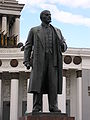 Lenin statue at the All-Russia Exhibition Centre, Moscow
 -
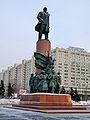 Lenin monument on Oktyabrskaya Square, Moscow
 -
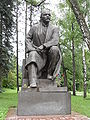 Lenin statue in Gorki Leninskiye
 -
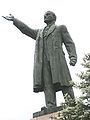 Lenin statue in Kineshma
 -
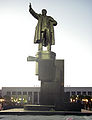 Lenin statue in Saint Petersburg
 -
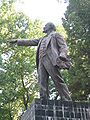 Lenin statue in Dushanbe
 -
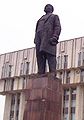 Lenin statue in Tula
 -
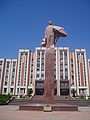 Lenin statue in Tiraspol
 -
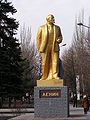 Lenin in Donetsk
 -
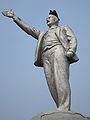 Lenin statue in Kolomna
 -
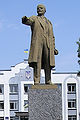 Statue in Borzna
 -
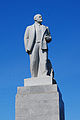 Statue of Lenin in Norilsk
 -
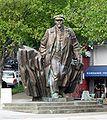 Statue of Lenin in Seattle
.JPG)


In popular culture
Film

- Sergei Eisenstein's October: Ten Days That Shook the World (1927) became an influential celebratory dramatization of the 1917 October Revolution.
- Three Songs About Lenin (1934) is a documentary silent film by Russian filmmaker Dziga Vertov.
- Lenin appeared as a character in the Soviet films Lenin in October (1937) and Lenin in 1918 (1939), both directed by Mikhail Romm.
- Sergei Yutkevich directed a series of films about Lenin, featuring Maxim Straukh. These include The Man With the Gun (1938), Yakov Sverdlov (1940), Stories of Lenin (1957), Lenin in Poland (1966) and Lenin in Paris (1981).[140]
- Lenin was portrayed by Michael Bryant in the 1971 film Nicholas and Alexandra.
- All My Lenins (1997) is a historical comedy by Hardi Volmer.
Television
- Lenin was portrayed by Patrick Stewart in the 1974 BBC miniseries Fall of Eagles.
See also
References
Notes
- ↑ Триумф и Трагедия И. В. Сталин: политический портрет. (Triumph and Tragedy – I. V. Stalin : A Political Portrait) Дмитрий Волкогонов (Dmitriy Volkogonov). Book 1, Part 1, pp. 95–114. Новости Publications. Moscow. 1989.
- ↑ The Rise of Stalinsim socialistappeal.org
- ↑ Stalin Kills the 1923 Revolution C.L.R. James, §: THE SIGNIFICANCE OF 1923
- ↑ The New Statesman Interview - Barbara Castle
- ↑ Christopher Read, Lenin, Abingdon: Routledge (2005), p. 4.
- ↑ 6.0 6.1 Christopher Hill, Lenin and the Russian Revolution, London: Penguin (1971), p. 35.
- ↑ 7.0 7.1 Ronald W. Clark, Lenin: The Man Behind the Mask, London: Faber and Faber (1989), p. 4.
- ↑ "Moscow Museum Puts Lenin's Jewish Roots on Display". The New York Times (New York). 23 May 2011. Archived from the original. Error: You must specify the date the archive was made using the
|archivedate=parameter. http://www.nytimes.com/aponline/2011/05/23/world/europe/AP-EU-Russia-Lenins-Secrets.html?_r=1&scp=1&sq=lenin%20jewish&st=cse. Retrieved on 27 May 2011. - ↑ http://www.time.com/time/world/article/0,8599,2077413,00.html
- ↑ Ronald W. Clark, Lenin: The Man Behind the Mask, London: Faber and Faber (1989), pp. 4, 9.
- ↑ Vladimir Ilyich Lenin, What Is To Be Done? (1902), Lenin Internet Archive.
- ↑ Volkogonov, Dmitri (1994). LeninTemplate:Ndash A New Biography. Free Press. p. 8. ISBN 0-02-933435-7.
- ↑ 13.0 13.1 13.2 13.3 Lenin entry from the International Encyclopedia of the Social Sciences, 1968
- ↑ Christopher Read (2005) Lenin: 16
- ↑ 15.0 15.1 15.2 15.3 Biography (TV series) - Vladimir Lenin, Voice of Revolution, A&E Network, 2005, ASIN B000AABKX6
- ↑ Hill, Christopher, Lenin and the Russian Revolution (1971) Penguin Books:London p. 36.
- ↑ Service, Robert. Lenin: A Biography. London: Pan. ISBN 0-330-49139-3.
- ↑ Read, Christopher Lenin (2005) p. 18.
- ↑ Danilov, Eugene (Moscow, 2007). Lenin: Secrets of Life and Death. Zebra E. p. 181. ISBN 978-5-17-043866-2.
- ↑ J. Brooks and G. Chernyavskiy (2007) Lenin and the Making of the Soviet State. Bedford/St Martin's: Boston and New York
- ↑ 21.0 21.1 Lenin, V.I. (Written in 1896–1899; First printed in book form in March 1899; Published according to the text of the second edition, 1908). "The Development of Capitalism in Russia: The Process of the Formation of a Home Market for Large-Scale Industry". Archived from the original. Error: You must specify the date the archive was made using the
|archivedate=parameter. http://www.marxists.org/archive/lenin/works/1899/devel/index.htm. Retrieved on 16 March 2007. - ↑ The Development of Capitalism in Russia
- ↑ Paul Le Blanc (1908) Revolution, Democracy, Socialism, Selected Writings of Lenin. London, Pluto Press p. 9
- ↑ Rupert Woodfin (2004) Introducing Marxism. Royston: Icon Books: 89–90
- ↑ Christopher Read, Lenin, Abingdon: Routledge (2005), pp. 60–1
- ↑ Rupert Woodfin (2004) Introducing Marxism. Royston: Icon Books, p. 91
- ↑ 27.0 27.1 Read, Christopher, Lenin (2005) p. 81.
- ↑ http://www.pbs.org/wgbh/commandingheights/shared/minitextlo/ess_leninscritique.html
- ↑ Read, Christopher, Lenin (2005) p. 86.
- ↑ Harding, Neil, Lenin's Political Thought (1986), p. 250.
- ↑ Clar, Ronald W. Lenin: the Man Behind the Mask (1988) p. 154.
- ↑ Read, Christopher, Lenin (2005) pp. 132–4.
- ↑ Paul Bowles (2007) Capitalism. Pearson: Harlow: 93
- ↑ Lenin, V. I., Imperialism, the Highest Stage of Capitalism (2000) New Delhi: LeftWord Books p. 34
- ↑ Christopher Read (2005) Lenin. London: Routledge: 116–26
- ↑ Christopher Read (2005) Lenin. London: Routledge: 144
- ↑ 37.0 37.1 37.2 N. K. Krupskaya, Reminiscences of Lenin (1933), Krupskaya Internet Archive.
- ↑ Orlando Figes, A People's Tragedy: The Russian Revolution 1891–1924, London: Pimlico (1996), p. 384.
- ↑ Ronald W. Clark, Lenin: The Man Behind the Mask, London: Faber and Faber (1989), pp. 210–1.
- ↑ 40.0 40.1 40.2 Vladimir Ilyich Lenin, The Tasks of the Proletariat in the Present Revolution (a.k.a. The April Theses) (1917), Lenin Internet Archive.
- ↑ Orlando Figes, A People's Tragedy: The Russian Revolution 1891–1924, London: Pimlico (1996), p. 388.
- ↑ A. J. P. Taylor, 'Introduction', in John Reed, Ten Days That Shook the World, London: Penguin (1977), xviii.
- ↑ Orlando Figes, A People's Tragedy: The Russian Revolution 1891–1924, London: Pimlico (1996), p. 387 n.
- ↑ Read, Christopher (1996). From Czar to Soviets: The Russian People and Their Revolution, 1917–21. Oxford University Press. pp. 151–153. ISBN 0-19-521241-X.
- ↑ Read, Christopher, Lenin (2005): 157–60
- ↑ Read, Christopher, Lenin (2005): 158–61
- ↑ Read, Christopher, Lenin (2005): 160–1
- ↑ Template:Ru icon Biography of Grigory Aleksinsky at Hrono.ru
- ↑ Trotsky, Leon. "The Month of The Great Slander". The History of the Russian Revolution; Volume 2,Chapter 27. Archived from the original. Error: You must specify the date the archive was made using the
|archivedate=parameter. http://www.marxists.org/archive/trotsky/works/1930-hrr/ch27.htm. - ↑ Read, Christopher, Lenin (2005): 162–3
- ↑ Lenin, Vladimir (1917). "The State and Revolution". Archived from the original. Error: You must specify the date the archive was made using the
|archivedate=parameter. http://www.marxists.org/archive/lenin/works/1917/staterev/index.htm. - ↑ 52.0 52.1 Sheila Fitzpatrick, The Russian Revolution, Oxford: Oxford University Press (2008), p. 60.
- ↑ Sheila Fitzpatrick, The Russian Revolution, Oxford: Oxford University Press (2008), pp. 60–1.
- ↑ V. I. Lenin, 'The Russian Revolution And Civil War: They Are Trying To Frighten Us With Civil War', Rabochy Put ('The Workers' Path') No. 12 (29 September 1917), Lenin Internet Archive.
- ↑ Orlando Figes, A People's Tragedy: The Russian Revolution 1891–1924, London: Pimlico (1996), pp. 481, 491.
- ↑ Orlando Figes, A People's Tragedy: The Russian Revolution 1891–1924, London: Pimlico (1996), pp. 489–90.
- ↑ Orlando Figes, A People's Tragedy: The Russian Revolution 1891–1924, London: Pimlico (1996), p. 490.
- ↑ John Reed, Ten Days That Shook the World, London: Penguin (1977), p. 128. (Available online, courtesy of the Marxists Internet Archive.)
- ↑ John Reed, Ten Days That Shook the World, London: Penguin (1977), pp. 129–137. (Available online, courtesy of the Marxists Internet Archive.)
- ↑ 60.0 60.1 John Reed, Ten Days That Shook the World, London: Penguin (1977), p. 143. (Available online, courtesy of the Marxists Internet Archive.)
- ↑ 61.0 61.1 Ronald W. Clark, Lenin: The Man Behind the Mask, London: Faber and Faber (1988), p. 279.
- ↑ Orlando Figes, A People's Tragedy: The Russian Revolution 1891–1924, London: Pimlico (1996), p. 512.
- ↑ Lenin "Collected Works", vol. 31, p. 516.
- ↑ Lenin "Collected Works", vol. 30, p. 335.
- ↑ Christopher Read (2005) Lenin. London: Routledge: 212
- ↑ LENINE'S MIGRATION A QUEER SCENE, The New York Times, 16 March 1918
- ↑ "Archive of Lenin's works". Archived from the original. Error: You must specify the date the archive was made using the
|archivedate=parameter. http://www.marxists.org/archive/lenin/works/subject/women/index.htm. - ↑ The Impact of Stalin's Leadership in the USSR, 1924–1941. Nelson Thornes. 2008. pp. 3. ISBN 978-0-7487-8267-3.
- ↑ Leonard Shapiro, The Communist Party of the Soviet Union
- ↑ Leonard Bertram Schapiro. The Communist Party of the Soviet Union. Eyre & Spottiswoode, 1970. ISBN 0413279006 p.183. See also: Lenin and the First Communist Revolutions, V
- ↑ 71.0 71.1 Black Book of Communism, p. 79
- ↑ Ronald W. Clark, Lenin: The Man Behind the Mask, London: Faber and Faber (1988), ISBN 978-0060158026, p. 456.
- ↑ V. I. Lenin, 'Anti-Jewish Pogroms' (1919), Lenin Internet Archive.
- ↑ Volkogonov, Dimitri. LeninTemplate:Ndash A New Biography. New York: Free Press. p. 229. ISBN 0-02-933435-7.
- ↑ Pipes, Richard, The Russian Revolution (Vintage Books, 1990) p.807
- ↑ Dr. V. Bonch-Bruevich, Lenin's attending physician, Tri Pokusheniia na V. Lenina, 1924.
- ↑ Krassin, Lubov, Leonid Krassin: His Life and Work, by his wife (1929) Skeffington: London
- ↑ Clark, Ronald, Lenin: The Man Behind the Mask (1988) p. 373
- ↑ Red Terror
- ↑ Gellately, Robert (2007). Lenin, Stalin, and Hitler: The Age of Social Catastrophe. Knopf. pp. 57. ISBN 1400040051.
- ↑ Trotskii, Dnevniki i pis'ma, 100-1, cited in Figes, Orlando (1997). A People's Tragedy: The Russian Revolution 1891–1924. Penguin Books. p. 638. ISBN 0198228627.
- ↑ Greg King and Penny Wilson (2003) The Fate of the Romanovs. Hoboken, Wiley: 294
- ↑ Adrian Blomfield. Russia exonerates Tsar Nicholas II The Telegraph, October 1, 2008.
- ↑ Volkogonov, Dmitri (2006). Lenin: A New Biography. Free Press. p. 212. ISBN 0-02-933435-7.
- ↑ Orlando Figes. A People's Tragedy: The Russian Revolution 1891–1924. Penguin Books, 1997 ISBN 0198228627 p. 630
- ↑ Figes, Orlando (1998). A People's Tragedy: The Russian Revolution: 1891–1924. Penguin. pp. 649. ISBN 0-14-024364-X.
- ↑ Volkogonov, Dimitri. LeninTemplate:Ndash A New Biography. New York: Free Press. p. 238. ISBN 0-02-933435-7.
- ↑ Figes, Orlando (1998). A People's Tragedy: The Russian Revolution: 1891–1924. Penguin. pp. 524–25. ISBN 0-14-024364-X.
- ↑ Robert Gellately. Lenin, Stalin, and Hitler: The Age of Social Catastrophe. Knopf, 2007 ISBN 1400040051 p. 65
- ↑ Melgunov, Sergei, Red Terror in Russia (1975) Hyperion Pr, ISBN 0-88355-187-X. See: The Record of the Red Terror
- ↑ Lincoln, W. Bruce, Red Victory: A History of the Russian Civil War (1999) Da Capo Press.pp. 383–385 ISBN 0-306-80909-5
- ↑ Leggett, George (1987). The Cheka: Lenin's Political Police. Oxford University Press. pp. 197–198. ISBN 0198228627.
- ↑ Orlando Figes. A People's Tragedy: The Russian Revolution 1891–1924. Penguin Books, 1997 ISBN 0198228627 p. 647
- ↑ Black Book of Communism, p. 80
- ↑ 95.0 95.1 "Twentieth Century AtlasTemplate:Ndash Death Tolls". Archived from the original. Error: You must specify the date the archive was made using the
|archivedate=parameter. http://users.erols.com/mwhite28/warstat1.htm#Russian. - ↑ Black Book of Communism, p. 82
- ↑ Christopher Read (2005) Lenin. London: Routledge: 251
- ↑ Pipes, Richard (1996). The Unknown Lenin: From the Secret Archive. Yale University Press. pp. 152–154. ISBN 0-300-06919-7.
- ↑ Template:Cite journal
- ↑ Donald Rayfield. Stalin and His Hangmen: The Tyrant and Those Who Killed for Him. Random House, 2004. ISBN 0375506322 p. 85
- ↑ Pipes, Richard (1994). Russia Under the Bolshevik Regime. Vintage. pp. 141–166. ISBN 0679761845.
- ↑ Lenin, Vladimir (1915). "The Revolutionary Proletariat and the Right of Nations to Self-Determination". Archived from the original. Error: You must specify the date the archive was made using the
|archivedate=parameter. http://www.marxists.org/archive/lenin/works/1915/oct/16.htm. - ↑ "An exchange of letters on the BBC documentary Lenin's Secret Files". World Socialist Web Site. 6 March 1998. Archived from the original on 13 February 2007. http://web.archive.org/web/20070213155724/http://www.wsws.org/correspo/1998/mar1998/leni-m06.shtml. Retrieved on 16 March 2007.
- ↑ Carr, E.H. (1966). The Bolshevik Revolution 1917–1923, Part 2. pp. 233. Chase, W.J. (1987). Workers, Society and the Soviet State: Labour and Life in Moscow 1918–1929. pp. 26–27. Nove, A. (1982). An Economic History of the USSR. pp. 62. "Flewers, Paul, War Communism in Retrospect". Archived from the original. Error: You must specify the date the archive was made using the
|archivedate=parameter. http://www.whatnextjournal.co.uk/Pages/Back/Wnext5/Warcomm.html. - ↑ Black Book of Communism pp. 92–97, 116–121.
- ↑ "Lenin and the First Communist Revolutions, VII". Archived from the original. Error: You must specify the date the archive was made using the
|archivedate=parameter. http://www.gmu.edu/departments/economics/bcaplan/museum/his1g.htm. - ↑ E.H. Carr (1979) The Russian Revolution From Lenin to Stalin 1917–1929. London, Macmillan: 14
- ↑ E.H. Carr (1979) The Russian Revolution From Lenin to Stalin 1917–1929. London, Macmillan: 14, 16–17, 46–8
- ↑ Lenin, quoted in Prabhat Patnaik "Introduction" to Imperialism, the Highest Stage of Revolution. New Delhi, Leftward Books, p. 8
- ↑ Robert Payne (2008). Mao Tse-Tung Ruler of Red China. READ BOOKS. p. 22. ISBN 1443725218. http://books.google.com/books?id=I2cSSVPogpoC&pg=PA22. Retrieved on 2010-06-28.
- ↑ Great Soviet Encyclopedia. 1980. p. 237. http://books.google.com/books?id=vnOFYI3g-N4C. Retrieved on 2010-06-28.
- ↑ Aleksandr Mikhaĭlovich Prokhorov (1982). Great Soviet encyclopedia, Volume 25. Macmillan. http://books.google.com/books?id=mF0NAQAAMAAJ&pg=PA237. Retrieved on 2010-06-28.
- ↑ Bernice A Verbyla (2010). Aunt Mae's China. Xulon Press. p. 170. ISBN 1609574567. http://books.google.com/books?id=lSVK8qxOsG8C&pg=PA170. Retrieved on 2010-06-28.
- ↑ Jonathan Fenby (2005). Chiang Kai Shek: China's Generalissimo and the Nation He Lost. Carroll & Graf Publishers. p. 504. ISBN 0786714840. http://books.google.com/books?id=GTgEPrlfvG4C&pg=PA337. Retrieved on 2010-06-28.
- ↑ New York Times
- ↑ Триумф и Трагедия – И. В. Сталин: политический портрет. (Triumph and Tragedy – I. V. Stalin : A Political Portrait) Дмитрий Волкогонов (Dmitriy Volkogonov). Book 1, Part 1, pp. 114. Новости Publications. Moscow. 1989.
- ↑ Триумф и Трагедия – И. В. Сталин: политический портрет. (Triumph and Tragedy – I. V. Stalin : A Political Portrait) Дмитрий Волкогонов (Dmitriy Volkogonov). Book 1, Part 1, pp. 111. Новости Publications. Moscow. 1989.
- ↑ Trotsky, L.D., "Concerning Eastman's Book Since Lenin Died", Bolshevik 16; 1 September 1925; p. 68. Concerning Eastman's Book Since Lenin Died minimising its significance. "In several parts of his book, Eastman says that the Central Committee concealed from the Party a number of exceptionally important documents written by Lenin in the last period of his life (it is a matter of letters on the national question, the so-called 'will', and others); there can be no other name for this, than slander against the Central Committee of our Party. . . . Vladimir Ilyich did not leave any 'will', and the very character of his attitude towards the Party, as well as the character of the Party, itself, precluded any possibility of such a 'will'. What is usually referred to as a 'will' in the émigré and foreign bourgeois and Menshevik press (in a manner garbled beyond recognition) is one of Vladimir Ilyich's letters containing advice on organisational matters. The 13th Congress of the Party paid the closest attention to that letter, as to all of the others, and drew from it the conclusions appropriate to the conditions and circumstances of the time. All talk about concealing or violating a 'will' is a malicious invention."
- ↑ Trotsky, Leon. My Life (1930) The Marxists Internet Archive
- ↑ Trotsky, Leon (1932). On the Suppressed Testament of Lenin. The Marxists Internet Archive. http://www.marxists.org/archive/trotsky/1932/12/lenin.htm. Retrieved on 16 March 2007.
- ↑ Gorin, Vadim, Lenin: A Biography (1983) Progress Publishers, pp. 469–70
- ↑ Mauchline Roberts, Elizabeth, Lenin and the Downfall of Tsarist Russia (1966) p. 92.
- ↑ See the article: А.М. и А.А. Панченко «Осьмое чудо света», in the book Панченко А.М. О русской истории и культуре. St. Petersburg: Azbuka, 2003. p. 433.
- ↑ V. Lerner, Y. Finkelstein and E. Witztum, "The enigma of Lenin's (1870–1924) malady". European Journal of Neurology, 2004, 11: 371–376
- ↑ En finir avec la momie de Lénine
- ↑ Голосование за и против захоронения тела Владимира Ленина началось в интернете
- ↑ Leon Trotsky (1939) "Lenin" in The Encyclopedia Britannica (Fourteenth Edition): 911–914
- ↑ Paul Le Blanc (2008) Revolution, Democracy, Socialism – Selected Writings of Lenin. London, Pluto Press: 24–5
- ↑ Christopher Read, Lenin, Abingdon: Routledge (2005), pp. 20, 64, 132–37
- ↑ Christopher Read, Lenin, Abingdon: Routledge (2005), pp. 2, 301
- ↑ Триумф и Трагедия – И. В. Сталин: политический портрет. (Triumph and Tragedy – I. V. Stalin : A Political Portrait) Дмитрий Волкогонов (Dmitri Volkogonov). Book 1, Part 1, pp. 110. Новости Publications. Moscow. 1989.
- ↑ http://www.marxists.org/archive/lenin/works/cw/index.htm%7CLenin's Works
- ↑ Trotsky, Leon (1930). Volume Three: The Triumph of the Soviets; Appendix No. 1.
- ↑ Template:Cite journal
- ↑ R Pipes & D Branderberger The Unknown Lenin Yale 1996
- ↑ Time 100:Vladimir Lenin by David Remnick, April 13, 1998.
- ↑ Top 25 Political Icons: Lenin by Feifei Sun, Time Magazine, February 4, 2011
- ↑ Template:Cite journal
- ↑ Maryland Government, St Petersburg/Leningrad Oblast
- ↑ David Robinson (1981) World Cinema 1895–1980. London, Methuen: 223
Further reading
- Template:Cite journal A review of Lars T Lih, Lenin Rediscovered: What is to be Done? in Context
- Cliff, Tony (1986). Building the Party: Lenin, 1893–1914. Haymarket Books. ISBN 1-931859-01-9.
- Felshtinsky, Yuri (2010). Lenin and His Comrades: The Bolsheviks Take Over Russia 1917–1924. Enigma Books. ISBN 1929631952.
- Fischer, Louis (2001). The Life of Lenin. Orion Publishing Co.. ISBN 1-84212-230-4.
- Gellately, Robert (2007). Lenin, Stalin, and Hitler: The Age of Social Catastrophe. Knopf. ISBN 1400040051.
- Gooding, John (2002). Socialism In Russia: Lenin and His Legacy, 1890–1991. Palgrave Macmillan. ISBN 0-333-97235-X.
- Hill, Christopher (1971). Lenin and the Russia Revolution. Pelican Books Ltd.. ISBN 978-0140212976.
- Kolakowski, Leszek and Falla, P. S. (2005). Main Currents of Marxism. W. W. Norton & Company. ISBN 0-393-06054-3.
- Leggett, George (1987). The Cheka: Lenin's Political Police. Oxford University Press. ISBN 0198228627.
- Lih, Lars T. (2008) [2006]. Lenin Rediscovered: What is to be Done? in Context. Chicago: Haymarket Books. ISBN 9781931859585.
- Lenin, Vladimir (2002). Revolution at the Gates: A Selection of Writings from February to October 1917 by V. I. Lenin. Verso Books. ISBN 1-85984-661-0.
- Pannekoek, Anton; Richey, Lance Byron (2003). Lenin as Philosopher. Marquette University Press. ISBN 0-87462-654-4. http://books.google.com/books?id=L89oAAAAMAAJ.
- Payne, Robert (1967). The Life And Death Of Lenin. Simon & Schuster. ISBN 0-671-41640-5.
- Pipes, Richard (1999). The Unknown Lenin: From the Secret Archive. Yale University Press. ISBN 0-300-07662-2.
- Rappaport, Helen (2010). Conspirator: Lenin in Exile. Basic Books. ISBN 9780465013951.
- Read, Christopher (2005). Lenin: A Revolutionary Life. Routledge. ISBN 0-415-20649-9.
- Service, Robert (2002). Lenin: A Biography. Belknap Press. ISBN 0-674-00828-6.
- Shub, David (1965). Lenin: A Biography. Penguin Books. ISBN 0-14-020809-7.
- Template:Cite journal
- Trotsky, Leon (1971). On Lenin: Notes Towards a Biography. Harrap. ISBN 0-245-50302-1.
- Tucker, Robert C. (1975). The Lenin Anthology. W. W. Norton & Company. ISBN 0-393-09236-4.
- Volkogonov, Dmitri (2006). Lenin: A New Biography. Free Press. ISBN 0-02-933435-7.
External links
- Template:Worldcat id
- Marxists.org Lenin Internet ArchiveTemplate:Ndash Extensive compendium of writings, a biography, and many photographs
- Marx2Mao.orgTemplate:Ndash Lenin Internet Library
- Lenin's speech (video)Template:Ndash Lenin's speech with subtitles
- Article on Lenin written by Trotsky for the Encyclopedia Britannica
- Reminiscences of Lenin by N. K. Krupskaya
- The Lenin Museum in Tampere, Finland
- Lenin and the First Communist Revolutions
- Lenin Internet Archive Biography includes interviews with Lenin and essays on the leader
- Mirrors of Moscow: Nikolai Lenin by Louise Bryant
- Nicolai Lenin His Life and Work by G. Zinovieff, Indiana State University
- The Personality and Power of Nikolai Lenin From Raymond Robins' Own Story by William Hard (1920)
- TIME 100: V.I. Lenin by David Remnick, 13 April 1998
- Template:YouTube
- The Ghosts of Lenin Abound by The Moscow News Weekly, January 15, 2009
- Lenin's Fight to Defend Working-class Power and Revolutionary Internationalism by The Militant
- Lenin's Funeral Train in its own museum next to Paveletsky Rail Terminal
- Template:Gutenberg author
Selected works
- The Development of Capitalism in Russia
- What is to be Done? [1]
- One Step Forward, Two Steps Back
- Reply by N. Lenin to Rosa Luxemburg
- Two Tactics of Social-Democracy in the Democratic Revolution
- Materialism and Empirio-Criticism
- The Right of Nations to Self-Determination
- Imperialism, the Highest Stage of Capitalism
- The State and Revolution [2]
- How to Organise Competition?
- The April Theses[3]
- The Proletarian Revolution and the Renegade Kautsky
- Left-Wing Communism: An Infantile Disorder [4]
- Lenin's Testament
- Lenin's last letter to Stalin
- Lenin's Complete Collected Works, in 55 volumes. (Russian)
Template:S-start Template:S-off Template:S-bef Template:S-ttl Template:S-aft |- Template:S-bef Template:S-ttl |- Template:S-mil |- Template:S-bef Template:S-ttl Template:S-aft |- Template:S-end


